A Refining Legacy That Spans Generations
From its founding in 1966 to becoming one of Pakistan's most strategically vital industrial establishments, National Refinery Limited was at the forefront of energy refining for over five decades — with every milestone marking our unwavering commitment to quality, safety, and national energy security.
Key Milestones
- First Lube Refinery commissioned
- 539,700 TPA capacity
- Strengthens national fuel supply
- Government assumes control
- Economic Reforms Order
- Shift to state-led direction
- Fuel Refinery launched (1.5M TPA)
- Integrated refining complex
- Full fuel product range enabled
- First BTX petrochemical plant
- Benzene, Toluene, Xylene
- Industrial & defense supply
- Propane Recovery Unit commissioned
- Locally engineered & built
- Second Lube Refinery added
- Advanced global technology
- Most complex refining unit in Pakistan
- Major refinery revamp
- Capacity rises to ~2.71M TPA
- Efficiency & fuel quality improved
- Control shifted to Petroleum Ministry
- Sector-focused governance
- 7.5 MW power generation installed
- Reduced external power reliance
- Improved operational stability
- Lube II revamp with ExxonMobil
- +14,800 TPA capacity
- High-grade lube production
- Product metering system deployed
- Radar gauging across tanks
- Improved accuracy & control
- SAP ERP upgraded (ECC6)
- Expanded digital capabilities
- Stronger performance systems
- CDU revamp to 65,000 BPD
- Diesel desulfurization (Euro-ready)
- Isomerization boosts gasoline
- Lube-I revamp completed
- Capacity: 17,000 BPSD
- Improved processing efficiency
- Euro-V diesel supply begins
- Cleaner fuel standards achieved
- Present Position
- 3 Refineries & BTX Plant
- Crude Processing: 3.05 Million Tons/Year
- LBO Production: 192,000 Tons/Year
Detailed Refining Milestones & Records
First Lube Refinery Commissioning
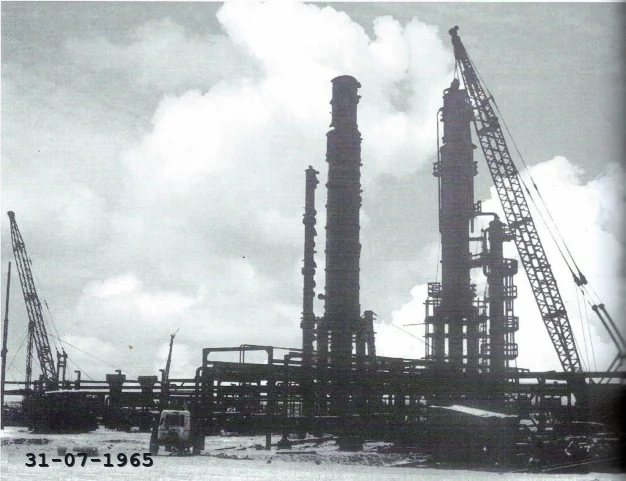
The construction work of the first Lube Refinery was started in May 1964. The Refinery came into production in June 1966 with a crude oil refining capacity of 600,000 tons per annum and production of 76,000 tons of various grades of Lube Base Oils and 100,000 tons of Asphalt per annum.
This refinery also supplemented fuel products requirement of the country, particularly Kerosene and Diesel.
Government Management Takeover
On January 16, 1972, the Government of Pakistan took over the management of the Refinery under the Economic Reforms Order. The overall managerial directions were entrusted to the Ministry of Production through State Petroleum Refining and Petrochemical Corporation Limited (PERAC).
Turnkey Fuel Refinery
The growth in demand for fuel products in the years following the installation of the First Lube Refinery drove the need to further increase refining capacity. In 1974, National Refinery Limited signed an agreement with Industrial Export and Import of Romania to construct a fuel refinery with a crude refining capacity of 1.5 million tons per year on a turnkey basis. Since the Fuel Refinery was to be integrated with the first Lube Refinery, the company selected a site on the same premises.
NRL's Fuel Refinery was a fresh addition to the country's growing industrial landscape. The Fuel Refinery was commissioned in 1977 to produce LPG, Motor Gasoline, HOBC, Naphtha, Kerosene, Jet Fuels (JP-1, JP-4), High Speed Diesel Oil (HSD), and Furnace Oil.
BTX Petrochemical Plant
To meet the country's demand for petrochemicals/solvents, particularly benzene, Toluene, and Xylene, and to meet Defense requirements, installing a BTX plant was deemed feasible. The BTX plant also had feedstock available from the Fuel Refinery. A Petrochemical BTX plant was therefore installed in 1979, capable of producing 25,000 Metric tons of Benzene, Toluene, and Xylene.
The country's first petrochemicals unit was integrated with the Fuel Refinery units. This plant can meet the country's feedstock requirements for aromatic, solvent, and explosives production and, through exports, is a source of foreign exchange earnings for the country.
Propane Recovery Unit (PRU)
In order to meet high purity Propane requirement for extraction and refrigeration at various units of Lube Refinery, a Propane Recovery Unit was installed and commissioned in 1980. Detailed engineering and fabrication for the entire plant was done locally. The plant is designed to produce 1,200 tons per annum of high purity Propane, which meets the requirement of both Lube Refineries.
Second Lube Refinery
In the early 1980s, industrial growth in Pakistan changed the supply-demand dynamics of petroleum products. The fuel business was saturating, while a captive market for lube oils existed in the region. In view of this, NRL installed its second Lube Refinery, commissioned in 1985, to produce 100,000 tons of Lube Base Oils. The feedstock for this Lube Refinery was available as surplus Furnace Oil from the Fuel Refinery, which was upgraded to Lubes. CE Lummus of U.K. carried out basic engineering and design work for this project under consultation with Texaco Development Corporation of USA.
Through concerted efforts, a refinery representing the latest technology has emerged at the highly impressive NRL Complex. The completion of the second Lube Refinery has created the country's largest and most comprehensive crude oil refining complex.
Fuel Refinery Revamp & Platforming Unit
Fuel product demand in the country grew strongly in the late eighties; however, the cost-effectiveness of projects gained greater importance. Thus, to keep pace with modern refineries and reduce the processing cost per barrel of crude, NRL implemented its Fuel Refinery Revamp Project in 1990. The revamp project was based on Energy Conservation, enabling a 15,000 BPSD capacity increase without increasing energy consumption. After the revamp, NRL's total crude processing capacity increased to about 3.0 million tons per year.
The platforming unit was balanced and modernized in 1995, and larger reactors were installed in 1997. It increased high-octane reformate production by 70%, creating potential for high-quality unleaded motor gasoline.
Corporate Control Transfer
The corporate control of National Refinery was transferred to the Ministry of Petroleum & Natural Resources.
Self Power Generation (7.5 MW)
Based on the principle of cogeneration from a high-pressure steam boiler, a 7.5 MW power generation unit has been installed to reduce dependence on purchased power. Commissioned in 2000, the Self-Power Generation System, in addition to conserving energy and supplying low-cost electricity, also helps reduce production losses due to power supply interruptions.